Wednesday, October 30, 2013

Retangling the Spaghetti Theory of Conspiracy 1

http://img.wonkette.com/wp-content/uploads/2012/12/messy-baby-e1356816916195.jpg

In 1987, Robert Anton Wilson wrote "The Spaghetti Theory of Conspiracy" as an introduction to a work of fiction on alien conspiracies. In his essay, Wilson advances the view that conspiracies are ubiquitous and ever-present but at the same time the idea of One Big Conspiracy is a complete myth.

Contending In The Night


Wilson begins by clearly explaining the fact, now widely known, that the real power in this world does not lie with governments but with the international banks that provide them credit. He explains,

...governments cannot do anything—good or ill, wise or foolish—unless the banks first lend them the money for the project. The power is in the banks. The governments survive on the permission of the banks. If the banks cut off their credit, governments die. Any government that resists has its credit cut off and dies.

It is obvious that this form of financial control involves conspiracy. Bankers conspire to further their own interests and manipulate governments with credit and debt to do so. This blog has covered this process in depth in a previous post.
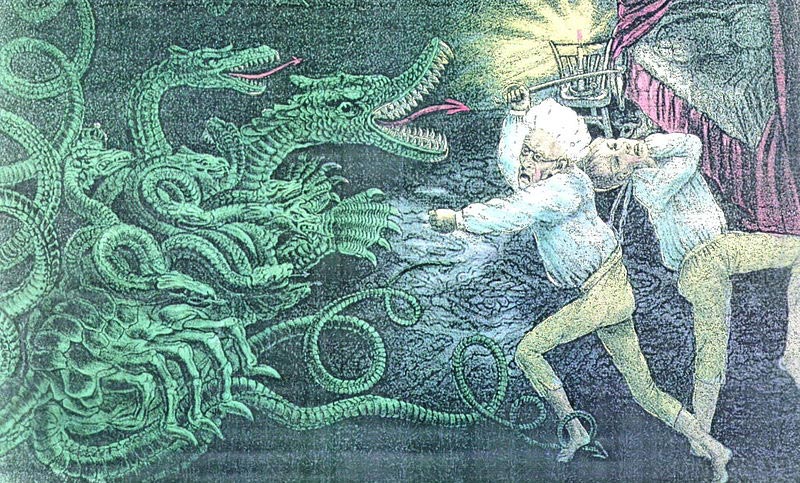
http://totallyhistory.com/wp-content/uploads/2011/08/Andrew-Jackson-vs-Bank.jpg

Wilson makes it clear that conspiracies are nothing new. In fact, conspiracy may be a major factor in evolution as a whole. Life itself is a conspiracy.

Conspiracy is the first manifestation of intelligent life.

The original organic molecules formed affinity groups and conspired to exploit the resources of this planet. Working in small cells originally, these DNA conquistadores quickly developed organizations of higher complexity and spread a network of hungry, predatory Life over the previously dead Earth. In less than 3,500,000,000 years this network has expanded from the ocean beds to the very peaks on the Himalayas. No square centimeter of Earth is uninfested.

http://i.cbc.ca/1.1550424.1379045380!/httpImage/image.jpg_gen/derivatives/16x9_620/hi-bacteria-852.jpg

RAW is kidding around here to some extent, but it is evident that he did seriously hold conspiracy to be a necessary factor of biology. This view, though, leads him to conclusions that are unpopular to dogmatic believers in One Big Conspiracy.

From this evolutionary perspective, every paranoid is partly right. The major error of the paranoid appears to be his characteristic belief in one jumbo Mega-Conspiracy that explains everything. This is impossible, because it violates basic laws of primate psychology. Domesticated primates like wild primates are mischievous, sly and have a keen sense of humor: the double-cross is their most characteristic invention.

As in every other level or niche of nature conspiracies are characterized by diversity. The multiplicity of life choices and strategies of competition and cooperation make any long-term conspiracy completely unstable. Power relations are fluid in nature and the wielders of political and economic power in human societies are certainly no exception to this. The "double-cross" is everywhere evident.

George Washington, who rose to power by conspiring against his king, said with blunt honesty, "Nations have no permanent allies, only permanent interests." This is why governments, corporations and other large-scale conspiracies all have a natural life-span, like other living systems. There is no government on this planet that has existed in its present form for more than 200 years; aside from the Dutch East India Company, most corporations rise and fall within 100 years (average). Outside of paranoid fantasy and Romantic fiction, most conspiracies collapse of their own"internal contradictions"within months or years.

It is as big a mistake, then, to claim that there no conspiracy as it is to assert that One Big Conspiracy controls everything. As Carl Oglesby puts it in The Yankee and Cowboy War,

... a multitude of conspiracies contend in the night.... Conspiracy is the normal continuation of normal politics by normal means . . . and where there is no limit to power, there is no limit to conspiracy.


The spaghetti theory brings us to a sort of shifting Middle Way position on conspiracies. It is opposed to the random, nihilist view of the daily headlines and the Official Story that there are no conspiracies, but it is equally against the absolutist assertion that One Evil Cabal controls the entirety of reality. Both the nihilist and absolutist extremes are too simplistic. It is much more accurate to take the kaleidoscopic view. Reality is complex and shifting, and mutating, evolving conspiracies exist at every level, sometimes cooperating and sometimes in deadly competition. 

Like spaghetti on a plate, there are many strands and layers of conspiracies all twisted together in a single mass. Some strands are connected and some are fractured, but it is very difficult to tell where one ends and another begins. In fact, it is more like a nest of copulating but cannibalistic snakes writhing, slithering, humping and devouring each other in constant upheaval. Certain serpents may appear dominant at times, rising to the top of the nest, but this is but a temporary illusion. All remain subject to the diversity and complexity of nature.


Nucleus


In his classic 1956 study on the US ruling class, The Power Elite, sociologist C. Wright Mills earlier reached the same conclusions as Wilson. While the elites of the US military, corporations and major political parties are entirely interwoven and incestuous it would be an analytical error to assert that they constitute a unified conspiracy

The conception of the power elite and of its unity rests upon the corresponding developments and the coincidence of interests among economic, political, and military organizations. It also rests upon the similarity of origin and outlook, and the social and personal intermingling of the top circles from each of these dominant hierarchies. 

This conjunction of institutional and psychological forces, in turn, is revealed by the heavy personnel traffic within and between the big three institutional orders, as well as by the rise of go-betweens as in the high-level lobbying. The conception of the power elite, accordingly, does not rest upon the assumption that American history since the origins of World War II must be understood as a secret plot, or as a great and co-ordinated conspiracy of the members of this elite. The conception rests upon quite impersonal grounds.

http://www.meehanreports.com/millsbook.jpg

With this, however, Mills does not fall into the nihilist camp. Of course, elite conspiracies happen. They happen all of the time. But this does mean that one shadowy group effectively manipulates and directs all of history. Mills is firmly in the middle way, spaghetti faction of conspiracy analysis.

There is, however, little doubt that the American power elite — which contains, we are told, some of ‘the greatest organizers in the world’ — has also planned and has plotted. The rise of the elite, as we have already made clear, was not and could not have been caused by a plot; and the tenability of the conception does not rest upon the existence of any secret or any publicly known organization. But, once the conjunction of structural trend and of the personal will to utilize it gave rise to the power elite, then plans and programs did occur to its members and indeed it is not possible to interpret many events and official policies of the fifth epoch without reference to the power elite. ‘There is a great difference,’ Richard Hofstadter has remarked, ‘between locating conspiracies in history and saying that history is, in effect, a conspiracy ...’ 


In Superclass -- The Global Power Elite And The World They Are Making, published in 2008, author David Rothkopf takes Mills's analysis to an international level. There is a power elite but now they are global. Rothkopf argues that there are about six to seven thousand cosmopolitan, elite individuals, intermingled and incestuous in the same way that Mills describes, who effectively call the shots in the world today. As in Mills's study these elites are star players in government, high finance, military, the entertainment industry, etc., but with the financial players at the head of the pack. They are the type of people who private jet into summits like the World Economic Forum in Davos and the yearly Bilderberg meetings.

This superclass is also called "the transnational capitalist class" in post-Marxist analysis, and "the 1%" by the Occupy movement. In truth, they consist of far, far fewer than one percent of the human population. They represent a fraction of fraction of a fraction of a percent.

http://www.infiniteunknown.net/wp-content/uploads/2011/01/WEF-2010.jpg

Nowadays, it a common for even middle-class individuals, because of the Internet, easy mobility, intercultural sophistication, etc., to consider themselves "citizens of the world." How inconceivably more do these elites transcend national boundaries. How does lunch in Hawaii, dinner in Rome and an all-night trance party in Gokarna sound? The whole world is their playground and ashtray. Governments are their wind-up toys.

A 2011 Swiss study conclusively maps out the organizational structure that most of these elites operate within. Suitably titled, "The Network of Global Corporate Control," the paper explains that current corporate capitalism is a hydra-headed behemoth with a dense nucleus controlled by only 147 corporations, mutually owned and invested in by each other. This "super-entity" is in turn mostly made up of banks and other financial institutions.

http://makewealthhistory.files.wordpress.com/2011/11/network.jpg?w=610

The most high-performing and/or influential members of the super-entity is the superclass. Skimming through the "company overview" pages of Businessweek's website brings this all to light. Here we can look up US cabinet ministers who sit on the boards of Fortune 500 companies, are rectors of ivy league universities, are the chair persons of NGOs, etc. The whole rotten bowl of spaghetti is laid out right in front of us. These are the Masters of the Universe. Our freedom comes when their rule ends.

As Mills emphasized over and over, though, these people very rarely engage in what could be called specific conspiracies. Of course sinister plots happen quite often, but what is more significant, more valuable in terms of analysis, is the simple fact that these relatively few individuals are in constant communication.

They are peers in the broadest sense of the word. This has not changed from Mills's time to our own. These elites may not be in agreement about most things, but they are in lockstep consensus when it comes to protecting their own class interests. If this is conspiracy then it is fluid and continuous.


Metaparanoid


The global power elite, centred around financial interests, is indeed a network. As a network its flexibility is its strength. A network, though, also has a great weakness. It depends on trust. It is dependent on more or less reliable information between its nodes. If it doesn't have this, as in the "credit crunch" of 2008, it seizes up. It ceases to function effectively. This is precisely where the meta-monkeywrenchers sneak in to pour sand into the gas tank of the global corporate machine. Enter WikiLeaks.

http://lapilgrim.narod.ru/earthfirstmonk.gif

Everyone is aware of WikiLeaks. We think of it as a pesky but plucky little organization that publishes documents, provided by whistle blowers like Chelsea (formerly Bradley) Manning, containing embarrassing details that governments and corporations would very much not like the general public to know about.

If WikiLeaks was only this, assuming its sincerity, this would itself be a necessary and heroic service for the 99+%, but essays surfacing in 2010 and written by WikiLeaks founder, Julian Assange, show the organization to have vastly more profound and radical objectives in mind.

Assange's key essay, "State and Terrorist Conspiracies," is broken down very nicely on the Zunguzungu blog.  In this essay Assange explains that elite rule is protected and sustained through the authoritarian instruments of the state. The most successful authoritarian states keep these repressive instruments hidden as much as possible.

Authoritarian regimes give rise to forces which oppose them by pushing against the individual and collective will to freedom, truth and self realization. Plans which assist authoritarian rule, once discovered, induce resistance. Hence these plans are concealed by successful authoritarian powers. This is enough to define their behavior as conspiratorial.

Effective resistance must be prevented at all costs and the best way to ensure this is to keep the public in the dark. The societies with the least resistance are those who do not have any idea that they are being oppressed. This is the optimal condition for the ruling class, both nationally and globally.

http://i1.ytimg.com/vi/Wlb1bdU-G7o/hqdefault.jpg

As Assange and Zunguzungu go on to explain, though, the more that an authoritarian organization keeps its operations secret, the more its communications are closed. As Zunguzungu interprets Assange:

And his underlying insight is simple and, I think, compelling: while an organization structured by direct and open lines of communication will be much more vulnerable to outside penetration, the more opaque it becomes to itself (as a defense against the outside gaze), the less able it will be to “think” as a system, to communicate with itself. The more conspiratorial it becomes, in a certain sense, the less effective it will be as a conspiracy. The more closed the network is to outside intrusion, the less able it is to engage with that which is outside itself (true hacker theorizing).

An inescapable paradox is identified and pounced upon. As an institution increasingly tries to keep secrets it increasingly becomes less able to trust its own internal communications. It no longer knows if it is getting the full picture. It gets a classic case of paranoia. "Leaking" only accelerates this process. The more leaks that are discovered, the more communication has to be clamped down upon, and the less that can be definitively known.

http://images.wikia.com/thefearmythos/images/5/56/Paranoia.gif

He [Assange] decides, instead, that the most effective way to attack this kind of organization would be to make “leaks” a fundamental part of the conspiracy’s information environment. Which is why the point is not that particular leaks are specifically effective. Wikileaks does not leak something like the “Collateral Murder” video as a way of putting an end to that particular military tactic; that would be to target a specific leg of the hydra even as it grows two more. Instead, the idea is that increasing the porousness of the conspiracy’s information system will impede its functioning, that the conspiracy will turn against itself in self-defense, clamping down on its own information flows in ways that will then impede its own cognitive function. You destroy the conspiracy, in other words, by making it so paranoid of itself that it can no longer conspire.

This is the real point of all of the major leaks we've witnessed in recent years. The "Iraq War Logs," the U.S. State Department Diplomatic "cables," etc. all assist in creating an atmosphere of mistrust within the affected institutions. Edward Snowden's leaks on the vast NSA spy apparatus have the same effect. More than just making people aware of how their privacy is being constantly and minutely invaded it causes massive systemic mistrust.

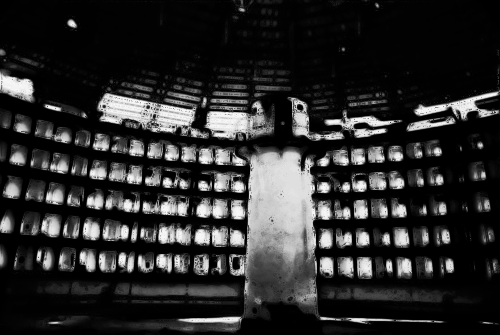
All in all, diplomats are afraid to talk to other diplomats, spies are afraid to talk to other spies, governments are afraid to talk to other governments. No one knows what is going to get leaked, who is listening to whom, who is being set up for what. And so things begin to get even more cryptic to the point of total opacity, confusion, breakdown and silence. Or at least that's Assange's theory.
http://cdn.mhpbooks.com/uploads/2010/09/panopticon-sketch.png

Platinum Blonde


But who is Assange anyway? Could it be, as many suggest, that both he and his organization are themselves conduits of disinformation and subversive tools of Empire? Why hasn't WikiLeaks, the argument goes, published any information about the 9/11 conspiracy? Why is Assange so dismissive of inquiries into 9/11? Is Julian Assange himself an intelligence agent?

Conspiracy theorists point to several things to support this claim. They are suspicious of the fact that Assange has been publicly dismissive of conspiracy research. They claim that the leaks that Assange and Co. have released have never really harmed Israel in particular. And they have special doubts about Assange's background.

http://wikileaks.org/IMG/jpg/Julian_Assange_Speaks_to_EU_Parliament.jpg

Assange formed a hacking group called the International Subversives and was arrested in 1991 for a hack on the Nortel corporation. Assange's sentence was reduced and it was later revealed that Assange subsequently cooperated with Australian authorities in the Victoria Police Child Exploitation Unit. Conspiracy theorists suspect that Assange has never stopped being a police asset.

There is possible evidence, though, that Assange has been used and abused by the powers that be long before 1991. Theorists highlight the involvement of Assange's mother and her former boyfriend with the San­ti­nike­tan Park Asso­ci­a­tion, an Australian New Age cult also called the Family or the Great White Brotherhood. This group, led by Anne Hamilton-Byrne, reportedly

con­di­tioned chil­dren with drugs, sen­sory depri­va­tion, sleep depri­va­tion, torture and rit­ual sexual abuse in order to pro­duce sub­jects who bent to the will of the group’s leader.

According to this theory, Assange at an early age was subjected to a wide array of MK Ultra-style mind control techniques and is even now an active Manchurian Candidate, however conscious he may be of this fact. Conspiracy theorists point to Assange's monotone voice and even his platinum colored hair, syncing with Hamilton-Byrne's preference for "Aryan" looking children, to support these claims.

http://spitfirelist.com/wp-content/uploads/2010/09/hamiltonbyrnefamily.jpg

Assange himself, in an interview with the New Yorker, has only spoken of being "on the run" from his mother's ex-boyfriend whom he suspected was a member of the cult:

Assange recalled her [his mother] saying, “Now we need to disappear,” and he lived on the run with her from the age of eleven to sixteen. When I asked him about the experience, he told me that there was evidence that the man belonged to a powerful cult called the Family—its motto was “Unseen, Unknown, and Unheard.” Some members were doctors who persuaded mothers to give up their newborn children to the cult’s leader, Anne Hamilton-Byrne. The cult had moles in government, Assange suspected, who provided the musician with leads on Claire’s whereabouts.

Whatever the real extent of Assange's connection to this cult it is sufficient, in the minds of many conspiracy theorists, to cast a dark shadow of suspicion on the entire WikiLeaks project. Surely, they argue, it is nothing but an advanced disinformation campaign.

http://chaukeedaar.files.wordpress.com/2011/12/warning_this_sign_is_only_a_distraction.jpg?w=300&h=225

Bumstead's Word


And disinformation, for the elite conspirators, is the name of the game. Provide just enough truth to make a story plausible and then tweak the facts so that anybody who looks into it is led astray. On this subject Ex-CIA director William Casey, in a quote that widely circulates the net, stated the objective of the Agency very explicitly back in 1981:

We'll know our disinformation program is complete when everything the US public believes is false.

http://cdn.historycommons.org/images/events/a904_reagan_casey_2050081722-11477.jpg

This is a pretty terrifying statement and one wonders, observing both mainstream and "alternative" media, if the program has been completed. The only problem is that there is no real evidence that Casey ever said these words. Is the statement itself disinformation? Is it designed and disseminated in order to project a false image of CIA omniscience? How would it be possible to know one way or the other?

It is easy to imagine, though, that something like this program is in effect. Certainly it would be in the interest of an intelligence organization to keep the public disinformed. If so, however, how could the CIA protect its own agents from being disinformed? Presumably they would be provided with the real information. But how would they be sure that this information was real?

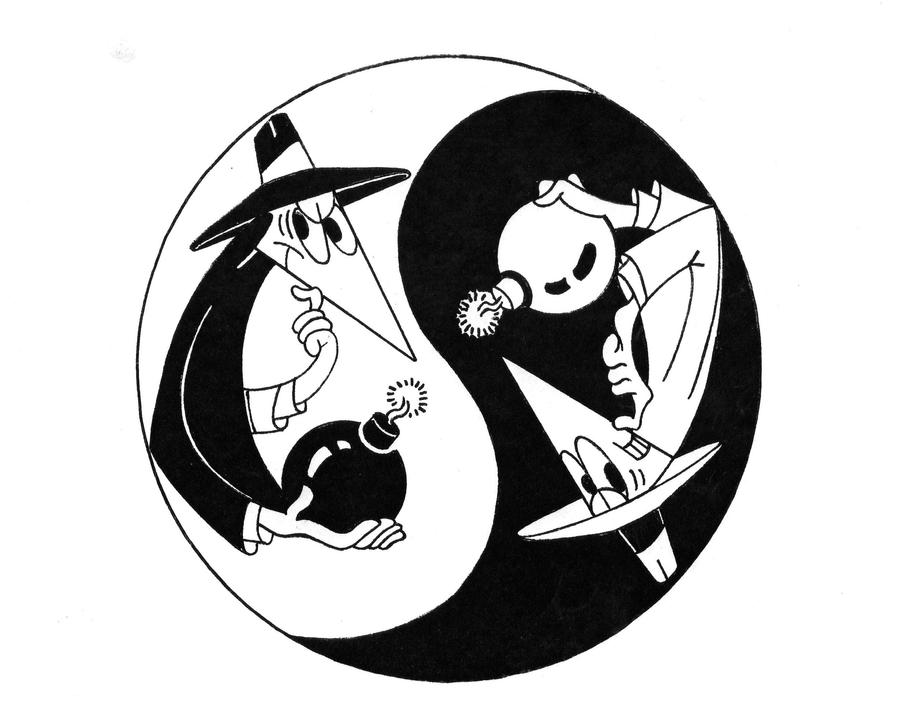
If, as we are led to believe, there are competing national intelligence organizations then wouldn't they all be trying to disinform each other? Wouldn't similar agencies in Russia, China, Israel, etc. be likewise attempting to totally disinform? And isn't this really just another facet of Assange's own theory?
http://fc00.deviantart.net/fs71/i/2010/259/9/c/spy_vs_spy_ying_yang_by_nes44nes-d1q0lgs.jpg

Even if Assange, unwittingly or not, is an agent of disinformation his theory still stands to reason. The more closed and paranoid an organization is, and the more unsure it is of receiving real information and protecting its secrets, the less effective it will be in dealing with real world problems. This seems axiomatic and it reveals and even greater meta-level to the spaghetti theory of conspiracy. No one can be entirely certain of anything that is presented as being real.

Robert Anton Wilson wrote of another aspect of this conundrum which he called the SNAFU Principle:

It’s what I call the “snafu principle.” Communication only occurs
between equals–real communication, that is–because when you are
dealing with people above you in a hierarchy, you learn not to tell
them anything they don’t want to hear. If you tell them anything
they don’t want to hear, the response is, “One more word Bumstead
and I’ll fire you!” Or in the military, “One more word and you’re
court-martialed.” It’s throughout the whole system.

So the higher up in the hierarchy you go, the more lies are being
told to flatter those above them. So those at the top have no idea
what is going on at all. Those at the bottom have to adjust to the
rules made by those at the top who don’t know what’s going on.
Those at the top can write rules about this, that and the other,
while those at the bottom have got to adjust reality to fit the rules
as much as they can.


The SNAFU Principle is a problem primarily of misinformation, individuals at the lower rungs of the hierarchy telling their superiors what they think their bosses want to hear, instead of disinformation but even this is not certain. How many workers willfully and maliciously tell lies to their employers?

If we combine Wilson's SNAFU Principle with Assange's theories and with the competing total disinformation campaigns, which may not exist but very plausibly do, of various intelligence agencies then the probability is very great that less and less people have any idea of what is really going on.

These kinds of conclusions are anathema to the believers in One Big Conspiracy. An assertion that the elite controllers of the System are basically as confused and mis/disinformed as the rest of us itself smacks of the worst type of disinformation. It causes us, they argue, to underestimate our rulers and it "muddies the water." It makes clear analysis impossible and therefore, as designed, it preempts effective resistance.

The Intentional Structure Of Turd


One Big Conspiracy theorists do not like contradictions. Only one consistent theory should be able to encompass all available facts. Details that do not conform to the emerging picture of absolute domination are rejected as being a part of the conspiracy, as being disinformation.

This is in direct opposition to the structuralist analysis of people like Noam Chomsky. Chomsky bases his criticism of the System on the available records -- media reports, publicly accessible government and corporate documents, eye witness accounts, historical texts, etc. These documents tend to shed light on the structure of institutions instead of the elite individuals who are manipulating and benefiting from these structures from behind the scenes and off the record.

http://i.telegraph.co.uk/multimedia/archive/01672/noam-2_1672791c.jpg

Other serious thinkers like Peter Dale Scott take a different approach. Scott, by no means a One Big Conspiracy believer, asserts that analysts and critics must look into the deep politics that are always present behind and beyond what we find in the public record.

Chomsky, and as an MIT professor dismissed as a "gatekeeper" by conspiracy theorists, will not speculate on what really happened on 9/11, during the Kennedy assassination, in the alleged CIA involvement in the drug trade, etc. because there is not enough textual evidence, he asserts, to support such speculation. Scott, in contrast, argues that of course such a record is lacking or hidden but by inference and with deep and informed research it is possible to discover the outlines of real conspiracy.

The problem with Scott's method is that speculation, if not rigorous and confined to strict limitations, is potentially endless. This is what is happening in the conspiracy theory milieu.

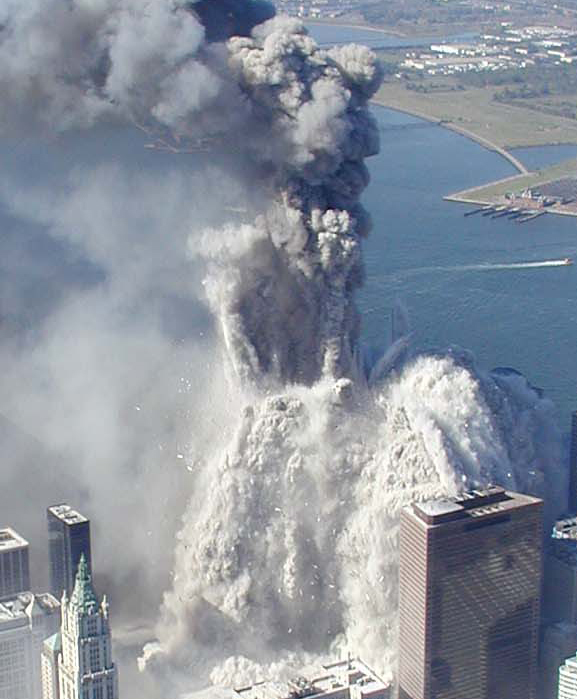
There seemed to be a time shortly after 9/11 when there were only two theories on what took place that day -- there was the official story and there was the conspiracy theory. The conspiracy theory, in brief, claimed that elements within the US government or ruling class, using Al Qaeda as either their dupe or scapegoat, purposely brought down the towers in New York and struck the Pentagon in order expand military operations and production and to implement a strict system of domestic surveillance.
http://www.drjudywood.com/home/bubbler.jpg

9/11 Truthers are still pretty much in agreement with this broad theory, but splits in the ranks revealed themselves very early in speculation about just how these attacks were carried out, and exactly by who. Were the planes remote controlled? Were there any planes at all? Were the towers brought down in a controlled demolition using thermite-type explosives? Were the towers vaporized by advanced, top secret scalar technology? Was it the CIA that really carried out the attacks? Was it the Mossad? Was it the Jesuits? The Freemasons? An even more sinister group?

As time progressed and positions hardened, factions formed along these lines. The "9/11 Truth Movement" became less like a movement and more like a loose collection of warring sects and tendencies. Each now accuses the other groupuscule as being an active promoter of divisive disinformation. Once again the spaghetti theory entwines it all.

Post-9/11, conspiracy theories have proliferated about every possible issue but always within this same pattern. It is not uncommon now to have conspiracy theories presented on both sides. There are no more official stories. There is no single alternative story. To expand on Oglesby: a multitude of conspiracy theories contend in the night.

Some "Truthers" accuse the CIA as being behind the recent coup against the Muslim Brotherhood in Egypt, others claim that it was a CIA-orchestrated pseudo-revolution that put the Brotherhood into power in the first place. Still others, perhaps paradoxically, argue that both of these positions are correct. Many researchers are now convinced of the use of "crisis actors" in heavily mediated events like the Sandy Hook shooting and the Boston Bombing. Others ardently argue that the whole theory of "crisis actors" is absurd and it is only promoted to make genuine researchers look ridiculous by association.


From the perspective of the conspiracy absolutists, however, this all makes sense. Of course those in power would do everything possible to confuse, waylay and disillusion sincere and spirited researchers. Disinformation plops the proverbial "turd in the punchbowl" and makes the entire scene seem pretty creepy. Instead of being presented with a clear case of elite corruption and foul play, an individual who has "woken up" will be sucked into a bewildering vortex of competing theories and personalities. There is a big temptation to roll over and go back to sleep.

There is really no doubt that such a strategy is taking place. Even if the disinformation campaign of intelligence organizations is not as total as the above quote by Casey suggests, it is in the best interest of those in power to keep a potentially informed opposition splintered and muddled. Is the absolutist position, therefore, correct? Are we being lied to literally about everything? Do only those at the very apex of the hierarchy have any idea what is truth?


Robert Anton Wilson certainly argues otherwise. There is a glaring contradiction at the heart of absolutist conspiracism. This can be illustrated in reference to the work of Alan Watt, found mostly at the website Cutting Through The Matrix.

Animal Farm


Alan Watt is arguably the most articulate and convincing proponent of the One Big Conspiracy theory on the net. Unlike David Icke, for instance, Watt does not insist that we are being ruled by shape-shifting reptilian overlords. Instead he tracks the objectives of the conspiracy, which consists of a bloodline of interbreeding elite families who have been the true power brokers of all the empires of history, through the writings of their own public intellectual representatives. These men include Carroll Quigley, H.G. Wells, Charles Galton Darwin, Bertrand Russell, etc. 

Watt, like all absolutists, believes that the elite conspiracy is behind every aspect of culture, every detail in history. The aim is total political, economic, biological, psychological and spiritual control of humanity.

https://blogger.googleusercontent.com/img/b/R29vZ2xl/AVvXsEjv8_KTAh0LvrTm019r-fHPv9A21dn9SOGKzM2MZibTfNiOB52tiTn5J_OubR8Cy0Vez2pY2jI_P-PL9LhFr02s_FDeBMJODhvpW-skaA-B1h24yl1Z33JbCE5x4WrvnGBso9Kl9kGAmK4/s400/pyramid_manipulation.jpg

Already, though, these elites reign in near omnipotence. Every item, every story, that appears in the media, including most of the internet, is only there because it has been carefully crafted to further their Agenda. While average individuals plan for the month or, at best, the year ahead, our "betters" plan in the span of decades and centuries. The secret technology that they employ against us is decades ahead of even the most state of the art devices available for public consumption. They truly are as gods. 

Week after week, in radio broadcasts and on his site, Watt is relentless and unwavering in his message -- we most resemble domesticated animals on a factory farm. We are bred ultimately for the slaughter. Any freedom that we imagine we have is deeply illusory. The best that we can hope for at this dismal moment is to keep ourselves informed of the extent and depth of the dark force that is sworn to extinguish the last sparks of our liberty and humanity. Through these recordings a future resistance may become possible, but there is no sign of this at present.

https://blogger.googleusercontent.com/img/b/R29vZ2xl/AVvXsEham8XdidOaglPMbOAai8r0nK8_MyqxxkSutKDqNaaxR0C_RVE-Mhz0AscqKyPDveOQGF2Ldh8BHko5ZkATTnPoWmMRqK0FD3r144D7CoUO-nvSYSjMzGTUG3vn5xJdtUwpkgjfUxJB-cUe/s250/images.png

I first came across Alan Watt on the Sweet Liberty radio show back in 2005 or 2006. I became mesmerized. On Sweet Liberty, Watt would occasionally mention how the big "alternative" radio networks, most especially GCN and RBN, were essentially CIA operations. It was weird for me, then, when Watt began to host a show on RBN (which he has just recently given up) and became a frequent guest on Alex Jones' (someone who Watt earlier decried as being a disinformation agent) flagship show on GCN.

Why would Alan Watt join RBN? And more significantly why would a CIA-controlled radio network allow such a radical voice on their airwaves?

There are a few possibilities here but each of these deeply challenges the absolutist conspiracy narrative:

1) Watt sold out. For the sake of fame and a bit of cash he went over to the dark side. This appears very unlikely. Watt's message has not changed since he got his show on RBN and he has maintained his independent voice. His fame and influence has certainly grown but I seriously doubt he is getting rich off of this. He seems sincerely convinced of the utter importance of his message and took any opportunity to reach a wider audience.

2) Watt has always been an agent. Watt began as a caller to obscure radio shows like Sweet Liberty, slowly building up his street cred and expanding his sphere of influence, and is now one the most respected voices in the field. This to me is also highly doubtful. Once again, it is Watt's sincerity which is most convincing. Unlike many others he does not sensationalize and he is not pushing his own agenda. If he is an agent he's one of the best.

http://images.dangerousminds.net/uploads/afiles/alexjones2fghjfhf-2.jpg

3) Watt is an unwitting tool to spread the myth of elite omnipotence. This is more probable. It could also be that Watt is fully aware that he is being used in this way but has concluded that it is the only way to reach a wider audience. In other words, he is using the system as it is using him.

4) Watt is wrong in his analysis -- we are not as controlled as he insists. Perhaps RBN and/or GCN are not controlled by the CIA or other nefarious organizations. Perhaps they are just what they claim to be.

The big problem with number 4 is if such large radio networks are essentially free of control, if Watt is wrong in this regard, then what else is outside of control? Certainly the conspiracy could not be total if this the case. If, on the other hand, numbers one, two or three are true, regardless of Watt's actual role, then the conspiracy may also not be as all-powerful as it lets on. Why would it need to promote a myth of omnipotence if it was truly god-like? Does it, like the Wizard of Oz, conclude that its power increases when the people believe it to be powerful?

http://godlessindixie.files.wordpress.com/2013/05/behind-the-curtain.jpg

Al Dente


The case of Alan Watt is really the whole of the absolutist position in a nutshell. The fact that conspiracy theorists exist either means that the control system is not as absolute as they insist or that their message is also being used as a device of control, which would indicate in turn that the system craves the omnipotence that it actually does not possess. In both cases the absolutist analysis falls short.

The nihilist position, that events are essentially random and coincidental, also fails. Conspiracies, in plural, are a fact. The only question is of their size and depth. What nihilists consider to be coincidences, conspiracy theorists take as being meaningful and intentional. The bigger the conspiracy is posited to be the more "coincidences" are resolved. When faced with coincidences the absolutist will simply absorb them into his theory. As coincidences are absorbed the conspiracy theory by necessity expands, often to seemingly absurd lengths.

To escape the endless complexity and groundlessness of the spaghetti theory of conspiracy, the absolutist needs to include more and more within his theory. The control system is viewed as being far beyond governments, intelligence agencies, elite families and even secret societies. The conspiracy moves beyond humanity, beyond this world, beyond this dimension. As RAW noted parenthetically in his essay:

(Thus, if there actually is one big jumbo-conspiracy governing this planet, it must be, as Donald Holmes wittily suggests in the following pages, of non-human origin.)

This is exactly where the spaghetti strand leads to next.

http://www.krackblog.com/wp-content/uploads/2010/09/Alien-Shaking-Hands-with-a-military-officer1-e1285594923689.png

Tuesday, September 17, 2013

Becomes So Odious

http://chadebeterraba.files.wordpress.com/2009/05/annex-chaplincharlie28moderntimes29_01.jpg

State Capitalism, Reason, Globalization, The Machine, The Techno-scientific Global Socioeconomic Supersystem, Separation, The New World Order -- all might be more accurately and conveniently replaced by Jacques Elull's term, "technique."

Elull, in The Technological Society, defines technique as:

The totality of methods rationally arrived at and having absolute efficiency in every field of human activity.


Technique, in this sense, is the sum of all methods governed by rationality and efficiency. While at one stage technique was just one facet among many (cultural, religious, political, etc.) in any given civilization it now dominates all other facets. Technique now is civilization. We exist in a technical civilization.

The terms State Capitalism and Globalization are too narrow. Technique has absorbed both the state and capital and is definitely a global process, but it is much more than this. State Capitalism, like the New World Order, implies an elite with subjective agency. Technique is purely a technical process which may favour certain elites but it is objective in nature. It is not governed by human will.


In contrast, the terms Reason and Separation are too broad, too general. Technique is a rational and reasonable process, but it is characterized only by applied reason -- reason that is almost instantly reified into some useful and practical technology or technique. Pure reason or pure science, like that favoured by the ancient Greeks who would invent things only to prove their theories and then would dismantle them, have little value for technical civilization.

Separation defines every aspect of technique -- compartmentalization, specialization, categorization, atomization -- the separation of technology from the rest of nature, the separation of individuals from one another etc., but its meaning reaches far outside of these bounds.

"The Techno-scientific Global Socioeconomic Supersystem" is more accurate but its use is cumbersome. "The Machine" is still more exact and concise but Ellul didn't use this term because during the time of his writing, the Fifties and Sixties, technique included things like schedules, programs, operations, statistics, and processes that were mechanical, like all techniques, but were not yet incorporated into machines.


Now, however, all of the above have been computerized -- as Elull predicted. In this way everything is machine based. "The Machine" can also be used as an accurate term to call technique and technical civilization.

Elull, wishing to avoid the notion that technique is somehow an intended, subjective process, denies that philosophy or mythology have anything to do with its emergence. Instead he points to five purely historical factors to explain its arising. It is easy to spot the lingering Marxist dogma of historical materialism in this view. The view of this blog, in contrast, is that technical civilization is only the physical embodiment or hard-wiring of dualistic mythology.

This happens as follows: Elull explains that technique really started to take shape around 1750 in Europe and vastly accelerated with the Industrial Revolution. The Industrial Revolution, he explains, first occurred in England and then in France because of the accumulation of capital in the financial hubs of these two countries. The accumulation of capital is one of the crucial economic reasons, Elull points out, that allowed for the advent and domination of technique. But how did capital accumulate in centres like London and Paris?

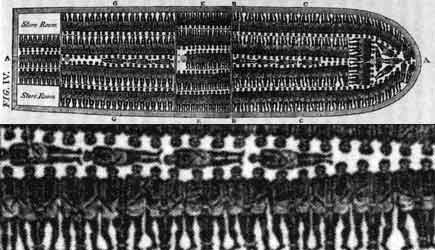
http://africanvop.files.wordpress.com/2013/08/157_atlantic-slave-trade.jpg

This process occurred as the direct result of the conquest of the Americas, Africa and Asia by European imperialism and the swamping of Europe by plundered, especially Mexican and Peruvian, gold that eventually made its way to English banks. This is the start of modern capitalism and industrialism, and therefore technique.

http://abagond.files.wordpress.com/2008/07/slaveship.jpg

Why did these imperialist conquests happen? Why was it Western Europe that started this particular ball rolling? One answer is that Western Europe was dominated by the dualistic mythology of Christianity, placing God over Nature and Christians over non-Christians. The imperialist conquests were only extensions of the Crusades and the Inquisition.


Technique therefore embodies this genocidal dualism into the very structure of our civilization. This is its essence.

Elull refers to the power of dualistic mythologies in the implementation of technique when he explains Marx's role in its onset. He explains that even during the nineteenth century technique was hated by the workers and Luddism was rampant. It took Marxism to convince the workers that technique would lead to their salvation to stop the movement of workers against it. Marxism is only a recent manifestation of dualist mythology. Marxism also divides the hell of the present from the glorious heaven of the future. Dualism and technique are one.

http://34489399.nhd.weebly.com/uploads/1/0/3/1/10310496/6693819_orig.jpg

Technique will expand until everything outside of its grasp becomes technicized. This includes all of nature, all cultures, all traditions, all imagination and the very structure of matter, life and mind. We are currently witnessing how diverse things like deforestation, pop culture, neuropharmaceuticals, genetic engineering and nanotechnology are rapidly taking us all to this bleak totality. There will be no freedom or autonomy outside technique -- and inside technique these terms have no meaning.

There seems to be no hope of reform or escape. Technique is interlocking, self-regulating and self-perpetuating. It continues to expand with exponential growth and velocity. There is no question of slowing it down without completely stopping it. As it becomes ever more huge and complex the need to police it in order to prevent errors or anomalies increases in proportion.

Technique is already totalitarian but its natural trajectory is to become a global police state. It needs to protect its own interests and as its interests grow so does its need for protection -- manifesting as security and policing techniques -- not sinister only very rational and efficient.

http://www.naturalnews.com/images/Police-House-Raid-Watertown-MA.jpg

Technique's greatest "enemy" (but it does not have enemies because it does not have emotions) is mystery, as Elull explains. Everything must be revealed under the harsh light of reason. Nothing can be left in the dark. Nothing can be hidden, nothing can be unconscious, nothing can be sacred. Nothing can be free, secret, wild or spontaneous. There can be no ecstasy. Everything must be efficient, ordered, useful and rational. Everything else must be transformed or destroyed. Mystery, herself, must be erased from existence.

It is obvious why the lovers of mystery aim to destroy the Machine. The Machine, realizing that people require mystery and ecstasy, devises techniques in order to simulate them. Thus we have abstract art, New Age, extreme sports, scandals, hip hop, drugs, pornography, raves, media, protests, etc. In short we have the technique of spectacle as a substitute for mystery. This is only effective to the extent that people believe in it. The spectacle needs to entertain faster than people's desires.

http://rutgersconsumersociety.files.wordpress.com/2012/11/article-1041224-0228ac4600000578-286_634x9424.jpeg

Ultimately, though, the Machine itself stems from mystery, persists within mystery, and will eventually collapse back into mystery. This is the only thing that gives hope.

Elull sees no hope (except in God but he does not write of this here) but he does mention "unpredictabilities." All technical solutions to technical problems have unpredictable consequences. Technique itself is bound by this. It cannot make itself perfectly efficient. Now, learning from chaos theory, we realize that the more complex a system is the more likely that small factors within the system will cause massive unforeseen effects. These, to the endless frustration of technique cannot be planned for. They are the "unknown unknowns."

They are the mystery of chaos bubbling up in the most ordered sectors of technical civilization. Mystery cannot be erased. Terrorist cells, computer viruses, epidemics, weeds through the concrete, illegal immigrants, bears in the cities, nervous breakdowns, farts in public -- insuppressible life! The more these are cracked down upon the more similar fissures of chaos will open up. Sixty years after Elull wrote his book we have all realized that mystery cannot be contained or disappeared.

http://novred.narod.ru/evrovavilon/08_Woman_cup.jpg

We worshipers of the non-dual mystery realize that technique emerged from mystery, will return to mystery and cannot destroy mystery however much it tries, but that technique is causing enormous suffering in the present hour.

It is destroying wilderness, autonomous cultures and unique ways of being. It is causing scarcity and extinction on an unprecedented scale. It is destroying all things worth living for and replacing them with consumer crap and toxic waste. In order to maintain its control it is turning the entire world into a police state fueled by endless war. It is a totalitarian nightmare.

http://thepolicytensor.files.wordpress.com/2013/05/bomb-explosion-mushroom-cloud.jpg

From a non-dual perspective it is also one with everything else, but also from this perspective the suffering it causes is intolerable. As non-dualists we can either go with the flow of what is happening, realizing that it is only mystery continuing to unfold and watch our own lives, bodies and minds become increasingly mechanical devices within technique, or we can ourselves become factors of unpredictability and creativity.

This second option is really the only acceptable option. The only true way to worship chaos is to become chaos. Technique cannot be reformed or regulated. Reforms and regulations only feed into it, help to refine and expand it, tighten our collective noose. The entire technical civilization must completely collapse.

http://mabuhaycity.com/photoplog/images/205/1_515890723_01abb08028_z.jpg

The harsh logic of the Unabomber (another inspired by Elull) makes a certain terrifying sense in this light: That because eventually (after it has utterly exhausted all of the Earth's resources -- after it has reached its absolute physical limit which is inevitable) the Machine will collapse and take everyone down with it, this line of thinking goes, it is better to destroy it now, potentially killing millions, then to wait for its natural collapse which will take out everything.

http://uzuncorap.com/wp-content/uploads/2012/03/obezite.jpg

If we successfully reform it we only postpone its collapse and therefore allow it to enslave more of life. Reform is not possible. Perhaps. But is its collapse really inevitable? Is the Machine's destruction of all life inevitable? The honest answer is no. Given mystery nothing is inevitable. It is also not certain, though, that if the Machine is successfully made to collapse that millions would perish. There is always hope for a miracle. Perhaps love will collapse the Machine -- very unlikely but this is the deepest hope.

There is also the chance that technique itself is accelerating towards the miraculous. As it advances in complexity it is also advancing in unpredictability ("our only enemy" according to Bushpig Sr.) Unpredictability increases to the point of singularity, where in all fields nothing can be predicted. This is beyond all rationality and speculation. It is information dark. This is beyond technique because it is beyond the rational and the efficient. It is beyond all categories. It cannot be determined if this is transcendence or collapse. This is the omega point, the bust of "2012" regardless, that we are all racing towards.

http://copypast.ru/uploads/posts/1344889942_ipgii_christ_1920x1080.jpg

Perhaps in the desire for the collapse of civilization the non-dual anarchists are only one of a huge number of unpredictabilities like terrorism, computer viruses, etc., but also like globalization, mass media, inter-cultural exchange and almost everything else out there -- all part of mystery's plan to dive back into mystery. This is apocalypse and it is only apocalypse (either personal or global) which will bring the mythology of dualism (at least temporarily) to its conclusion.

The terrorists are bringing on the apocalypse. Obama is bringing on the apocalypse. The internet welcomes it. Pandemics welcome it. Psychedelics bring it on. "Development" hastens its coming. More police make it happen that much sooner. Doing nothing, sitting in meditation, only invites the collapse of all things. Suburbs, Disneyland, riots, shopping malls, rising stock markets, oil, iPhones, aircraft carriers, the flu, Miley Cyrus, overpopulation -- these are all symptoms.

http://jto.s3.amazonaws.com/wp-content/uploads/2013/01/fl20130122lpa.jpg

We must all be ready for it at any moment, from any quarter. To prepare for it will also cause it to happen quicker. It is the physical, psychical limit to the Machine and it is already here. Praise Mystery in her divine dance to total revelation.

http://www.photoburst.net/travel-photography/2009/11/charak-puja-sylhet-bangladesh-canon-eos-40d-24-85mm-md-akhlas-uddin/charak-puja-sylhet-bangladesh-canon-eos-40d-24-85mm-md-akhlas-uddin.jpg

Sunday, August 25, 2013

Phat

http://edsonolimpio.files.wordpress.com/2012/09/image0021.jpg

We are all engaged in a deeper and deeper process of apophatic implosion. From negative theology to negative atheology and beyond to absolute emptiness.

First: God is declared to be beyond all name, form, category and definition. It is only accurate to say what He is not.

Second: God himself as "God" is viewed as merely a being of Being itself. It is Being which is the focus of all apophatics -- God carries too much cultural, historical, ethical and ontological baggage.

Third: But Being in itself is still trapped by the category of existence. Being must also be placed under erasure and disappear into Nothingness.

http://classconnection.s3.amazonaws.com/756/flashcards/1737756/jpg/emaciated1362186210759.jpg

Fourth: Nothingness, however, is itself categorized under the sign of negation and the lingering sign of transcendence which has clouded the process from the start. Nothingness must also be crossed out and all must be considered nothing.

Fifth: But as Nothingness is fully negated all forms and metaphors become possible again, although now they are all consciously empty of themselves. Metaphysics reappears as a respectable art but again as poetry, not as Truth. The sacred and the profane dissolve into one another. And God happily doubles, redoubles and exponentially multiplies her names and forms which are all sweet nothing.

http://photos1.blogger.com/blogger/6841/594/640/02-02-2006%2007%3B57%3B05PM.jpg

Sunday, August 18, 2013

137 tipkcoC

http://temp_thoughts_resize.s3.amazonaws.com/ed/a05c16fe9a645270166588e52bd50e/1l-split.jpg

From The Gut


137 is the inverse of 731. In northeast Asia, number 731 looms in the minds of many as being particularly ominous. The number 137, by chance or otherwise, is an equally powerful concern, although in a far less dark way, for a very different group of individuals. Are the two figures in any way related aside from their being chance numeric anagrams?  To answer this we must first tell the strange tale of 137.

The number 137, more accurately expressed as one over 137, is primarily associated in physics with the value of the fine-structure constant. I don't claim to be an expert on anything in this blog, least of all quantum physics. Specific information on what this term means mathematically can readily be found on the web, but it is not easily understood. As usual I'm interested more in the metaphorics of it all.

 \alpha = \frac{\cos \left(\pi/137 \right)}{137} \ \frac{\tan \left(\pi/(137 \cdot 29) \right)}{\pi/(137 \cdot 29)} \approx \frac{1}{137.0359997867},

There are simpler ways, though, to get some idea of what the fine-structure contant refers to. Here's a bit of explanation:

This number actually represents the probability that an electron will absorb a photon. However, this number has more significance in the fact that it relates three very important domains of physics: electromagnetism in the form of the charge of the electron, relativity in the form of the speed of light, and quantum mechanics in the form of Planck's constant. Since the early 1900's, physicists have thought that this number might be at the heart of a GUT, or Grand Unified Theory, which could relate the theories of electromagnetism, quantum mechanics, and most especially gravity.

The above quote gives some indication why 137 became such an obsession for many physicists. It's an obsession that comes from the GUT. Max Born reveals the stakes involved in this number:

If alpha [the fine structure constant] were bigger than it really is, we should not be able to distinguish matter from ether [the vacuum, nothingness], and our task to disentangle the natural laws would be hopelessly difficult. The fact however that alpha has just its value 1/137 is certainly no chance but itself a law of nature. It is clear that the explanation of this number must be the central problem of natural philosophy.


The significance of 1/137 (also expressed by its reciprocal -- approximately 137) was discovered in 1916 by Arnold Sommerfeld who assigned this new constant the Greek letter, Alpha. This first letter of the alphabet, alpha in Greek or alef in Hebrew, has tremendous esoteric importance, perhaps best illustrated by Jorge Borge's short story. Alpha is the perfect symbol for a number that many physicists believe could be a bridge between matter and ether, being and nothingness.  Richard Feynman was one of these scientists. From his book QED: The Strange Theory of Light and Matter:

It has been a mystery ever since it was discovered more than fifty years ago, and all good theoretical physicists put this number up on their wall and worry about it.) Immediately you would like to know where this number for a coupling comes from: is it related to pi or perhaps to the base of natural logarithms? Nobody knows. It's one of the greatest damn mysteries of physics: a magic number that comes to us with no understanding by man. You might say the "hand of God" wrote that number, and "we don't know how He pushed his pencil." We know what kind of a dance to do experimentally to measure this number very accurately, but we don't know what kind of dance to do on the computer to make this number come out, without putting it in secretly!


The physicist most associated with the number 137 preceded Feynman by a generation. Wolfgang Pauli was not only convinced of the number's role in finding a unified theory of physics, but he came to believe that it was a key to unlocking the secret of the human mind's interaction with the physical world. Writer Arthur Miller, in his Deciphering the Cosmic Number: The Strange Friendship of Wolfgang Pauli and Carl Jung, succinctly relates the number's importance for Pauli:

Pauli once said that if the Lord allowed him to ask anything he wanted, his first question would be “Why 1/137?

As a brilliant young physicist, though, Pauli was not free of problems. In fact, his life was falling apart. He came to realize that he could not solve these personal difficulties by himself.

In his physics, Pauli sought a unified field. But his personal life was one of
fragmentation and dissociation. Within one year, his mother poisoned herself in reaction to his father’s involvement in an affair, and Pauli plunged into a brief marriage with a cabaret performer. At thirty, he turned to Jung for help.


Three And Four


Upon meeting Pauli, Jung was quickly able to assess the young scientist's psychology. Pauli was a hard-nosed rationalist who was unable to express, in Jung's terms, feeling. 

I had a case, a university man, a very one-sided intellectual. His unconscious had become troubled and activated; so it projected itself into other men who appeared to be his enemies, and he felt terribly lonely because everybody seemed to be against him. Then he began to drink in order to forget his troubles, but he got exceedingly irritable and in these moods he began to quarrel with other men. . . and once he was thrown out of a restaurant and got beaten up.

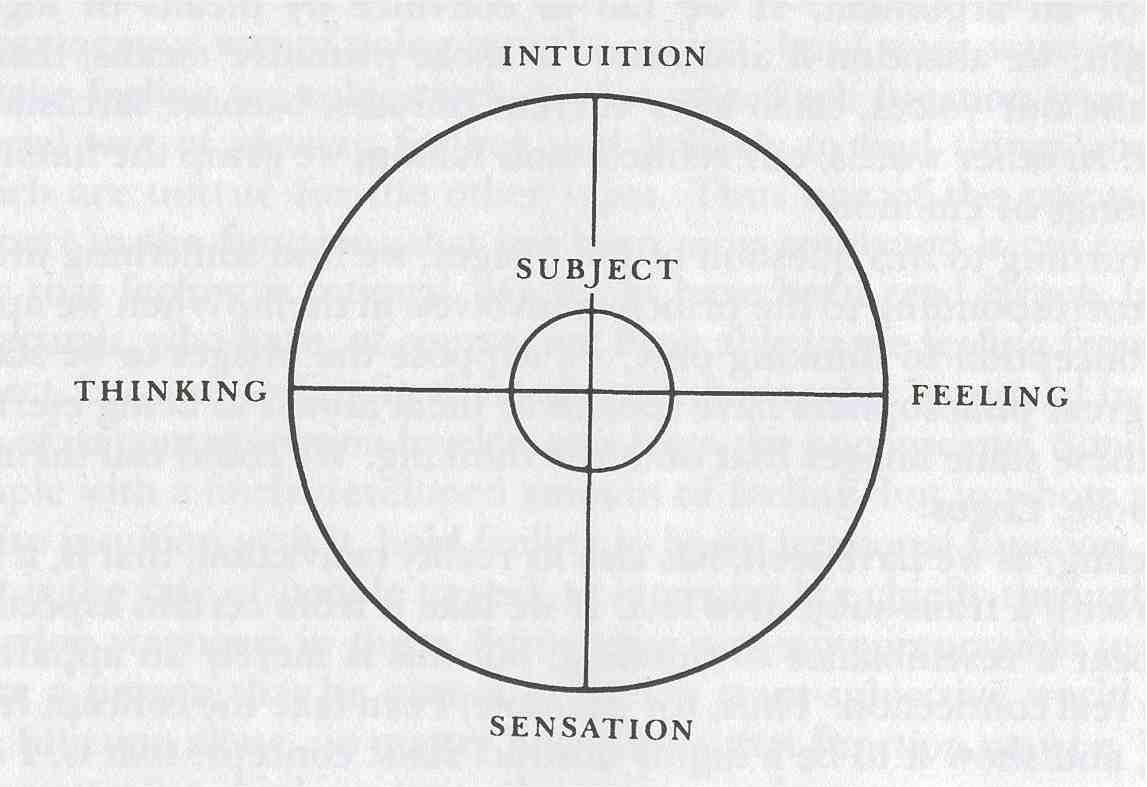
Jung identified four basic cognitive functions -- thinking, feeling, sensing and intuition. To simplify, a person's psyche achieves optimal health when these functions are more or less in balance. Jung came to realize that this fourfold view of the psyche meshed perfectly with traditional conceptions of a similar fourfold division of reality.

[redbook2]

Arthur Miller, in an entertaining presentation about his book at CERN, very skillfully lays out the relationship between Jung and Pauli. Miller explains that Jung's summation that Pauli was suppressing one of the four functions -- feeling -- went on to have a profound influence on Pauli's own research.

http://paulijungunusmundus.eu/hknw/typology_functions.jpg

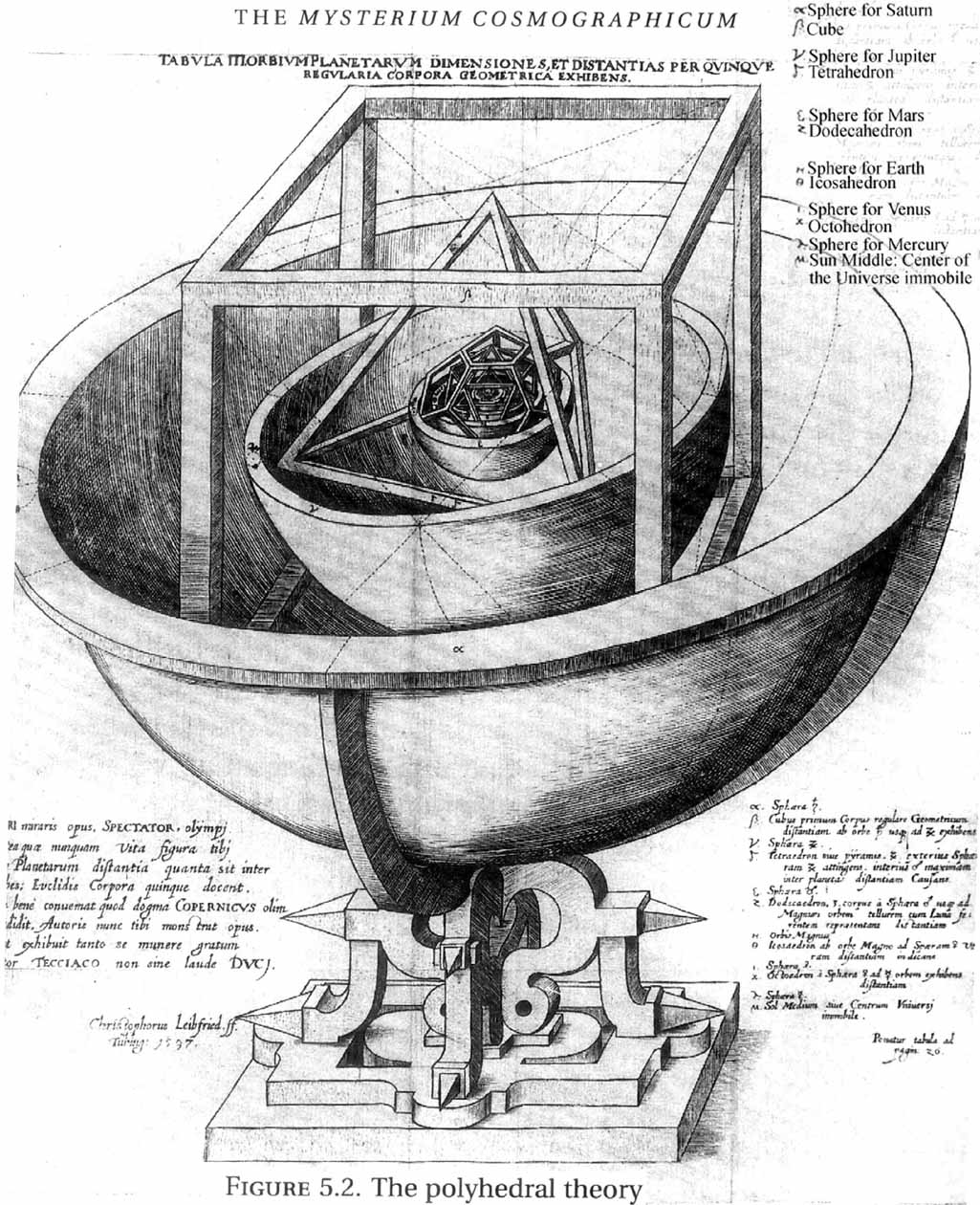
Pauli was a follower of Johannes Kepler, whose own scientific work was highly influenced by the Christian doctrine of the Trinity. Jung convinced Pauli that this emphasis on the number three was psychologically incomplete. It lacked the fourth, primarily female, element that Pauli was burying deeply in his unconscious. This had parallels with Pauli's development of the exclusion principle in physics.

During his time in psychoanalysis with Jung, Pauli was struggling with a question in quantum physics that Pauli ultimately resolved with the Exclusion Principle. This states: no two electrons in an atom can have the same four quantum numbers. Miller strongly suggests that it was Jung's influence on Pauli that enabled the latter to make this breakthrough by his positing a fourth quantum number. This is hinted in one of Pauli's letters, cited by Miller:

Thus, on the psychological line this time I have once again bumped into the problem of the transition from three to four. In neither case was it by any means Mr. C.G. Jung who suggested it to me, nor was there an advance conscious intention down. Consequently I am rather certain that objectively there is an important psychological and, perhaps, natural philosophical problem connected with these numbers.

http://www.mifami.org/eLibrary/Kepler-MystCosmoModelsm.jpg

Jung's sessions with Pauli largely consisted in the analysis of the physicist's dreams. Pauli, despite or perhaps because of his rationalism, was a prolific dreamer and was able to present hundreds of these nighttime visions to Jung. Jung, in turn, was delighted by the dreams and wrote about many of them, strictly maintaining Pauli's anonymity, in various books.  In Psychology and Alchemy, Jung wrote about what is now Pauli's most famous dream -- the vision of the "World Clock."

This remarkable vision made a deep and lasting impression on the dreamer, an impression of "the most sublime harmony," as he himself puts it... It is a three-dimensional mandala — a mandala in bodily form signifying realization.
 
For Jung this dream signified that the process of individuation was complete. Jung found that during prolonged psychoanalysis patients who were able to bring suppressed aspects of their psyche to light and in balance with the whole almost inevitably experienced dreams or visions of a circle or mandala. In his research, Jung discovered that the same symbol of the mandala contained this identical meaning in cultures across the globe. He realized that the mandala is the archetype of psychic wholeness. Pauli's "great vision" indicated that his psyche was finally integrated.

http://25.media.tumblr.com/tumblr_m1egpcG2wl1ropvm6o1_r1_400.jpg

Encountering Yourself


I'll return to a full description of Pauli's dream, which also shows a reconciliation of the three and the four, as this story unfolds. The important point for now is to know that the relationship between Jung and Pauli did not end after the latter had been "cured." In fact, it deepened. The patient became collaborator. Both realized that the other was the perfect partner in exploration of what each most wanted to know -- what is the precise relation between mind and matter? It quickly became apparent to the two that central to this question was the phenomenon of synchronicity.

Synchronicity, as a firm concept, did not really occur to Jung until around 1929. It is remarkable that the development of this idea a year later coincided with the appearance of a new patient, the brilliant young physicist, Wolfgang Pauli. The relationship that grew between Jung and Pauli is remarkable and well worth the telling, for it illustrates how scientists of that period were willing to entertain Jung's ideas about synchronicity, archetypes, and the collective unconscious, and even attempt to extend them into their own fields.

Pauli wanted to know how psychology affected physics and Jung was interested in the physics of psychology. Recently such inquiries are dismissed by most scientists as the obsessions of cranks, but at the time Jung and Pauli were at the top of their respective fields. It would not be until 1952 with his paper "Synchronicity: An Acausal Connecting Principle," which was originally published in Germany along with an essay by Pauli on archetypes in the work of Kepler, that Jung published his extensive views on synchronicity, influenced massively by Pauli.


Through their decades of collaboration, Jung and Pauli came to be convinced that synchronicity points to a basic unity of the subjective and the objective, of mind and matter. In a chapter,  "Science and the Unconscious," of Man And His Symbols the student and colleague of Jung, Marie-Louise von Franz, explains that other scientists beyond Pauli were also interested in these questions.

When examining nature and the universe, instead of looking for and finding objective qualities, "man encounters himself," in the phrase of physicist Werner Heisenberg. 

Because of the implications of this point of view, Wolfgang Pauli and other scientists have begun to study the role of archetypal symbolism in the realm of scientific concepts. Pauli believed that we should parallel our investigations of outer objects with a psychological investigation of the inner origin of our scientific concepts. 

http://profiles.nlm.nih.gov/ps/access/SCBCDX.jpg

Von Franz quotes from Pauli who, several decades before What the Bleep Do We Know!? and even The Tao of Physics, far more credibly challenged the idea of scientific objectivity:

The science of microphysics, on account of the basic 'complementary' situation, is faced with the impossibility of eliminating the effects of the observer by determinable correctives and has therefore to abandon in principle any objective understanding of physical phenomena. Where classical physics still saw 'determined casual laws of nature' we now look only for 'statistical laws' with 'primary possibilities.'

Beyond just this, however, von Franz concludes her essay with what was really on the minds of both Jung and Pauli -- the possibility of a unified theory of mind and matter.

The unexpected parallelisms of ideas in psychology and physics suggest, as Jung pointed out, a possible ultimate one-ness of both fields of reality that physics and psychology study -- i.e., a psychological one-ness of all life phenomena . . . The concept of a unitarian idea of reality (which has been followed up by Pauli and Erich Neumann) was called by Jung the unus mundus (the one world, within which matter and psyche and are not yet discriminated or separately actualized). He paved the way toward such a unitarian point of view by pointing out that an archetype shows a "psychoid" (not purely psychic but almost material) aspect when it appears within a synchronistic event -- for such an event is in effect a meaningful arrangement of inner and outer facts.

https://lh3.googleusercontent.com/-b_yKxI3agac/AAAAAAAAAAI/AAAAAAAAAB8/hMlkNluWu7I/photo.jpg

Wheeling And Dealing


The real goal is the discovery of the unus mundus. All synchronicity directs us towards this. But what part does the number 137 play in this realization? A paper on Jung and integral theory by Giorgio Piacenza Cabrera asks the same question and suggests a plausible answer:

If archetypes do exist in the Jungian sense and they possess a 'psychoid' aspect capable of 'organizing the fundamental principles of matter and energy in the physical world' what would the role of 1/137 be? Perhaps that of a 'master, coordinating archetype,' resting in an even deeper level (perhaps more psychic than physical) than that of the average archetype?

This idea of a number, especially one as significant as 137, as being a "master, coordinating archetype" is not at all contrary to the thought of Jung or Pauli. It very much agrees with them. Pauli wrote of the "Pythagorean" view of number that is found in the work of his own hero, Kepler.

I was well aware, as a pupil of Sommerfeld’s [who discovered the 1/137 constant], how these Pythagorean elements appearing in Kepler retain their vitality even today. That ancient spiritual ‘dynamics’ of number is still active, which was formerly expressed in the ancient doctrine of the Pythagoreans that number are the origin of all things and as harmonies represent unity in multiplicity.


Cabrera also cites Jung's similar idea on the qualitative significance of numbers, and how 137 may be the ultimate representative of these number archetypes:

Jung often refers to the old familiar saying: “in the Olympus numbers reign”. Following this pattern, we regard the supreme ruler of number archetypes the specific formula introduced for fine-structure constant. 

Archetypal numbers also prominently feature in Pauli's world clock dream. This is seen in the description of the dream which Jung provides in Psychology and Alchemy:

The "Great Vision":

There is a vertical and a horizontal circle, having a common centre. This is the world clock. It is supported by the black bird.

The vertical circle is a blue disc with a white border divided into 4 X 8 -- 32 partitions. A pointer rotates upon it.

The horizontal circle consists of four colours. On it stand four little men with pendulums, and round it is laid the ring that was once dark and is now golden (formerly carried by four children). The world clock has three rhythms or pulses:

1) The small pulse: the pointer on the blue vertical disc advances by 1/32.

2) The middle pulse: one complete rotation of the pointer. At the same time the horizontal circle advances by 1/32.

3) The great pulse: 32 middle pulses are equal to one complete rotation of the golden ring. 


The numbers three and four are key to this vision. The vertical wheel is connected to Pauli's rationalist emphasis on the number three, and the horizontal wheel, with its four divisions and figures, represents the integrated psyche. Together they form a complex but balanced mandala.

Jung was always careful not to suggest interpretations to his client's dreams, letting them come to their own conclusions. This was also the case with this particular dream by Pauli. While Pauli realized its enormous personal significance, it was Jung who was struck by its similarity to the great vision of Ezekiel.

I have always been particularly interested to see how people, if left to their own devices and not informed about the history of the symbol, would interpret it to themselves. I was careful, therefore not to disturb them with my own opinions and as a rule I discovered that people took it to symbolize themselves or rather something in themselves. They left it as belonging intimately to themselves as a sort of Creative background, a life-producing sun in the depths of the unconscious mind. Though it was easy to see that it was often almost a replica of Ezekiel’s vision, it was very rare that people recognized the analogy, even when they knew the vision which knowledge, by the way, is pretty rare nowadays.


Jung's linking of Pauli's World Clock with Ezekiel's Merkabah vision will take on greater importance as this narrative deepens. This blog has already examined the comparison of the vision of Ezekiel with the revelation of Beatrice to Dante at the summit of Mount Purgatory. Another connection with past studies is how Pauli's World Clock has obvious numerical ties to 432 (or 4 and 32). In addition to 432, though, it should be no surprise that Pauli's symbol of psychic wholeness is directly related to the number he was most intrigued by, 137.

This is summed up in a very fascinating paper by Valarki Nadai Bokor:

From the Pauli–Jung letters it is clear that the black bird is supported by the female symbolic figure of anima, where anima is suited with number ‘7’. In this way the black bird (1), the rotating discs and ring (3), and the figure of anima (7) altogether associates to number ‘137’.

Furthermore, the temporal structure (rotation scale) itself is double 32, and the spatial structure is also evidently 2 × (32 + 4) (the four little men with pendulums -- horizontal disc, and four cardinal positions of pointers – vertical disc), that altogether results in 1 + 2 × 32 + 2 × 36 = 137.

A more obviously synchronistic link to 137 comes with Jung's original account of this "Great Vision" in Psychology and Alchemy. The number of the footnote referring to this account is, by design or otherwise, 137!

Smashed Jugs


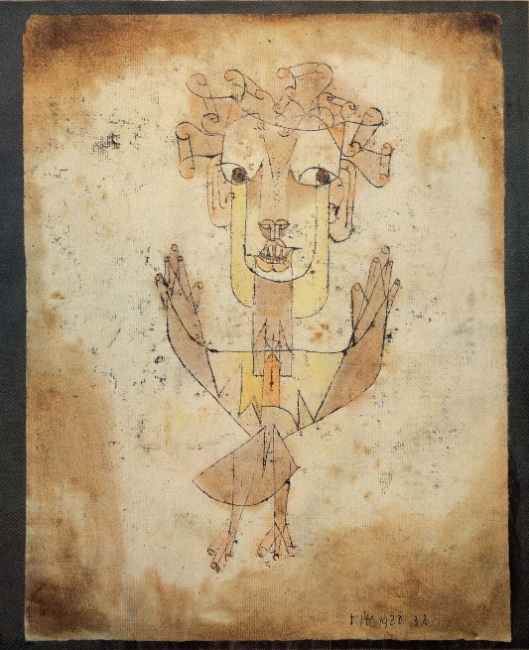
Both Jung and Pauli quickly came to realize that this number's mysterious qualities went well beyond the realm of physics. An often cited conversation between Victor Weisskopf, at one time an assistant to Pauli, and Gershom Scholem, the revered scholar of Jewish mysticism, brings this out clearly.

http://artdone.files.wordpress.com/2012/12/paul-klee-angelus-novus-1920-israel-museum-jerusalem.jpg?w=529&h=650

When Scholem met Weisskopf, he asked about the prominent unsolved problems in physics. Weisskopf said, “Well, there’s this number, 137...” And Scholem’s eyes lit up! He said, “Did you know that one hundred thirty-seven is the number associated with the Cabala?” 

By this, Scholem meant that the number values of the four Hebrew letters making up the word קבלה, or kabbalah (he=5, lamed=30, beth=2, qoph=100), sum to 137. This association of the Kabbalah with 137 is still very prominent. We see this in an article on number 137 by a member of the Kabbalah Centre, an organization made famous by Madonna and other celebrity members and discussed earlier in this blog.

http://img.gawkerassets.com/img/18iyfrqm4hc18jpg/k-bigpic.jpg

Billy Phillips writes about a discussion he had with the controversial rabbi and director of the Kabbalah Centre, Phillip Berg, on the mystical significance of the number 137:

The number 137 in physics corresponds to the interaction between an electron and a photon or the probability of an electron absorbing a photon. In the language of Kabbalah, it means the interaction between the Vessel and the Light or how a Vessel can absorb/receive the Light. We know that we are distanced and disconnected from the Light when we are opposite in nature because in the realm of consciousness or spirituality, opposites repel. The only way for our physical world (electron) to absorb (receive) the Light is to imitate the Light, behave like the Light, and that stops repulsion. In turn, it causes attraction.

Phillips stresses the same role of 137 as a bridge between matter (the Vessel) and mind or spirit (the Light) as was emphasized by Jung and Pauli. It may be that the Kabbalah (as 137) was "designed" to also be this bridge. The Kabbalah Centre is mainly focused on personal development (and it is often criticized by traditionalists), but it is clear that Phillips through Berg is presenting a highly simplified doctrine that is most notably found in the teachings of the 16th century Jewish mystic, Isaac Luria.


Two interrelated concepts emerge out of Lurianic Kabbalah that have direct bearing on Phillips' article and the number 137. These two concepts are known as Shevirat Ha-Kelim --  the "Breaking of the Vessels" and Tikkun --  the "restitution of a defect." These correspond to the Fall and Redemption on a truly cosmic scale.

Luria's teaching describes a complex process whereby, grossly simplified, the original, divine Light emanated out from En Sof, filled the body of the primordial, universal Man -- Adam Kadmon, burst out from his senses and began to flow into the ten Sefiroth of the Tree of Life. In Major Trends in Jewish Mysticism, Gershom Scholem explains what happened next:

Since, however, the divine scheme of things involved the creation of finite beings and forms, each with its own allotted place in the ideal hierarchy, it was necessary that these isolated lights should be caught and preserved in special ‘bowls’ created – or rather emanated – for this particular purpose. The vessels which corresponded to the three higher Sefiroth accordingly gave shelter to their light, but when the turn of the lower six came, the light broke forth all at once and its impact proved too much for the vessels which were broken and shattered. The same, though not to quite the same extent, also occurred with the vessel of the last Sefirah.

This, long before the earthly Adam or even Lucifer, was the original Fall. It became embedded into the fabric of reality. Fortunately or unfortunately, though, Luria viewed humanity as still being at the centre of the drama. The bowls or vessels had been broken, but the restitution or restoration of the Light to its rightful place is the task of us all.


The task of man has been defined by Luria in a simple but effective way as the restoration of his primordial spiritual structure or Gestalt. That is the task of every one of us, for every soul contains the potentialities of this spiritual appearance, outraged and degraded by the fall of Adam, whose soul contained all souls. From this soul of all souls, sparks have scattered in all directions and become diffused into matter. The problem is to reassemble them, to lift them to their proper place and restore the spiritual nature of man in its original splendor as God conceived it.

This task is both individual and collective, mundane and cosmic. Each soul or psyche contains the sparks, mired in matter, which trace their filaments or cilia of light back to pure Spirit. Is 137, the master number archetype of this process, the key to Tikkun? As a metaphor, and at risk of bastardizing both quantum physics and the Kabbalah, this can be accepted. It is the bridge of mind and matter, the fine-structure constant, the restorative essence of the Kabbalah.


Phillips takes it back to the personal. As such a bridge, it is most readily related to individual consciousness.

The missing puzzle piece for physics is consciousness. Only by way of consciousness can we absorb and connect to the Light in a lasting and permanent way. How? When we first admit and recognize that our ego is a distinct and separate force of consciousness (often that takes lifetimes), and then we strive to remove it, so that we share, instead of only receive, we then unite with the Light. In other words, the Light is the Cause of Happiness. Therefore, when we become the cause of someone else’s happiness, we are identical to the Light.

I could easily and justifiably get accused here of over-simplifying and/or misrepresenting Lurianiac Kabbalah, but in any case Scholem's research makes it clear that these beliefs are far older than the Kabbalah. The idea the the divine light became trapped in matter after a cosmic Fall is recognizably Gnostic. It is likely even more ancient than Hellenistic Gnosticism or Neoplatonism. Platonism, in general, has a very similar philosophy. And from Plato it can be traced back through Homer to even older sources.


In any case, Luria's philosophy is, I feel, uniquely profound. Tikkun is occurring on personal and cosmic levels. The reverse process is also still in effect. The ego is the usual means by which an individual buries the sparks of his soul even deeper. The selfish, self-limiting ego is an expression of the dysfunctional psyche. The sparks that Pauli was burying were linked to his inability to feel. 137 was for him a symbol of psychic wholeness.

Phillips corresponds the number 137 to the structure of Tree of Life itself. Whether or not this is philosophically legitimate, as a metaphor it is once again very powerful. In his article he includes the following graphic:


The fascinating point about this graphic, for the purposes of this post, is that the one, three and seven of 137 are shown descending from En Sof to the lower Sephirot. If we reverse this number we get 731 in ascent to the "Endless World." The three numbers can be combined and read in both ways.

Nymphomania


What is the significance of ascent and descent? 137 could represent, as suggested above, the descent of light into matter. In that case its inverse, 731, would represent the ascent of matter into the light -- or the capture of light by matter.

It is easy, though, to reverse the two. 731 depicts the restoration of light while descending 137 shows its original fall into matter. Ultimately it might be of little importance which interpretation we accept. A lightning strike, a common image in the Kabbalah, is an electric charge that simultaneously travels from the sky to the ground and from the ground up to the sky. Are the Fall and Redemption occurring at once?


Another poetic image perhaps symbolizing the same thing is found in the Odyssey.  In the 13th Book of Homer's epic, the poet writes of Odysseus' final return to the island of Ithaca. Homer describes a cave near the harbour where Odysseus is later able to stash his treasure. The most defining feature of this "Cave of the Nymphs" is that it has two openings or doors -- one to the north where mortal humans may descend and one to the south through which only immortals are able to make their ascent.

High at the head a branching olive grows
And crowns the pointed cliffs with shady boughs.
A cavern pleasant, though involved in night,
Beneath it lies, the Naiades delight:
Where bowls and urns of workmanship divine
And massy beams in native marble shine;
On which the Nymphs amazing webs display,
Of purple hue and exquisite array,
The busy bees within the urns secure
Honey delicious, and like nectar pure.
Perpetual waters through the grotto glide,
A lofty gate unfolds on either side;
That to the north is pervious to mankind:
The sacred south t'immortals is consign'd.

What exactly Homer meant to signify by these two gates has been a subject of speculation in Greek philosophy since at least the time of Plato. The most thorough study of this topic, though, was presented by the 3rd century Neoplatonic philosopher, Porphyry, in his On the Cave of the Nymphs in the Thirteenth Book of the Odyssey.

https://blogger.googleusercontent.com/img/b/R29vZ2xl/AVvXsEhxB36DtBOVjSzYYVXC69it9osARYX7Ry3XxrhvIhlU-f8KCsDFRgiwMu_W5EKa-6KDsZ5GPCQOMQziaPYHlOPOvECw3aon-3HkU5I49ZPIjkTVbsfOXzDhQDjy4TGtWeUqejIovhrIAdnm/s400/Sir_Edward_John_Poynter_%25E2%2580%2594_Cave_of_the_Storm_Nymphs.jpg

Porphyry deeply explores the symbolism of every detail in this passage, but just a few of these insights will suffice here. Porphyry explains that the north and south gates may represent Cancer and Capricorn respectively. Souls are able to descend to this world through the gate at Cancer and ascend, if they become immortal or purified, through the gate at Capricorn. Mixing metaphors, at the north gate the sparks of light (the soul) fall into matter and at the south gate the sparks are released and return to their source.  

Theologists therefore assert, that these two gates are Cancer and Capricorn; but Plato calls them entrances. And of these, theologists say, that Cancer is the gate through which souls descend; but Capricorn that through which they ascend. Cancer is indeed northern, and adapted to descent; but Capricorn is southern, and adapted to ascent. The northern parts, likewise, pertain to souls descending into generation. And the gates of the cavern which are turned to the north are rightly said to be pervious to the descent of men; but the southern gates are not the avenues of the Gods, but of souls ascending to the Gods.


File:AverroesAndPorphyry.JPG

Porphyry later turns his attention to the "bowls and urns" within the cave which he also associates with human souls. In a passage that reads very much like the teachings of Luria, he cites Plato and Hesiod and writes of souls being "tubs" or "vessels" which at times have their contents scattered and becoming "dispersed about matter":

But Plato in the Gorgias by tubs intends to signify souls, some of which are malefic, but others beneficent; and some which are rational, but others irrational. Souls, however, are (analogous to,) tubs, because they contain in themselves energies and habits, as in a vessel. In Hesiod, too, we find one tub closed, but the other opened by Pleasure, who scatters its contents everywhere, Hope alone remaining behind. For in those things in which a depraved soul, being dispersed about matter, deserts the proper order of its essence, in all these it is accustomed to feed itself with (the pleasing prospects of) auspicious hope.

This similarity of Luria to Porphyry supports Scholem's research on the Neoplatonic and Gnostic sources of the Kabbalah. Regardless of whether true parallels can be made between these very different systems of thought, we can continue the exploration of these numbers as potent and transformative metaphors.

Daimonic Possession


731, in its unfortunate connection with Unit 731, can be viewed to represent the ultimate Fall -- what Blake termed the "limit of opacity." Within Unit 731, and other similarly hideous centres of torture and experimentation on humans, the full depravity of material descent is shockingly revealed.

http://image.stirileprotv.ro/media/images/620xX/Mar2010/60412431.jpg

The episodes related to this unit in the X-Files accurately elaborate and extend this metaphor. The inhuman practices of Unit 731 are linked in the show to the most nightmarish accounts of the alien abduction phenomenon. It is not really a stretch of the imagination to conclude that the ultimate aim of such facilities is the unholy creation of a hybrid of the human and the demonic. This would represent the irretrievable capture of the Light by Matter.

In the research of Yeats and others, though, this blog has shown that these "intermediate" beings are not necessarily demonic or evil in character. Yeats called them by an older and more neutral or ambiguous term -- the "daimon." The nymphs or Naiades of Homer's cave are certainly daimons. Fairies are likewise daimons and, in more recent decades, the UFO and space alien definitely fit the bill.

In the cave in Ithaca (Blake's "mundane egg"), mortals could descend through one gate and immortals ascend through another. Presumably, though, the nymphs could travel back and forth through both. This is the unique characteristic of the daimon.

http://propagandum.files.wordpress.com/2011/09/mundane-egg-from-milton-blake1.jpg

Archetypes, themselves, contain this trait and the archetypes of number especially so. Daimons like archetypes are "psychoid" in nature. In addition to the word "Kabbalah" having the value in gematria of 137, the Hebrew word for "wheel" (owphan or אופן ) in the Book of Ezekiel also has a value of 137.

Now as I beheld the living creatures, behold one wheel upon the earth by the living creatures, with his four faces. (Ezekiel 1:15)

Many ufologists take Ezekiel's vision as an early documented UFO encounter. The "wheel" in a sense is the UFO. By analogy, then, the UFO is the number 137. Pauli's dream of the World Clock, compared by Jung to Ezekiel's vision, is an encounter of the UFO, of the mandala, of 137. This uncanny number also has the gematria value for the word "crucifix," a word which has obvious relation to the threshold of the divine and the human. 137 additionally is the 33rd prime -- 33 including the 32 paths of the Tree and the path beyond to the Ultimate.

http://www.williamhenry.net/gentle24.jpg

The number 137 now holds the fascination of those far outside of the field of physics. UFO researchers, Trish and Rob MacGregor, have written extensively on their their blog about the number and synchronicities involved with it. It does not seem surprising that individuals studying the UFO would also come under the spell of 137.

A far deeper level of inquiry, bordering on outright mania, into 137 is found on various forums on the web with mind-warping contributions from a number of researchers. One of the most outstanding of these is called Raphael. Everything written here, with the possible exception of its relation with 731 -- the main point of the post, would likely appear as very elementary to Raphael. Of the many connections he makes to 137, a fact about Noah's Ark is very relevant to this discussion.

http://upload.wikimedia.org/wikipedia/commons/b/b8/Noah%27s_Ark_on_Mount_Ararat_by_Simon_de_Myle.jpg

Raphael notes that the Ark, when its measurements are converted into metric, is approximately 137 metres in length. This matches the symbolism explored in this post. The Ark was the threshold between two ages. It, like the UFO, moves from one world/age to the next. As remarked in a previous post, the occultist A. E. Waite explains that the Ark has been connected to the Ark of the Covenant.

The Zohar says that the Ark of Noah was a symbol of the Ark of the Covenant, that his entrance therein saved the world, and that this mystery is in analogy with the Supreme Mystery.

The Ark of the Covenant is also a threshold vessel -- it allowed for communication between God and humanity. Both Arks act as daimons, and number 137, as well as its inverse 731, could be used to represent these transportive devices. Numbers, as Jung and Pauli believed, can also act as daimons. Patrick Harpur, in The Philosophers' Secret Fire, explains that this idea was actually quite common during the Renaissance:

Maths and numerology were the same thing. Numbers were Pythagorean personalities -- "perfect" or "friendly", for instance, or even Unutterable (alogon). They were daimons (or inseparable properties of the daimons they were used to invoke), which manifested a "mervaylous neutralitie" between the sensory and super-celestial worlds.

http://www.commeaucinema.com/images/galerie/big/69043_8e1bc9c5657818e23cdaab71a6bbad93.jpg

137, as a "master, coordinating archetype," as a bridge between mind and matter, as synchronicity expressed as number, is certainly this type of numeric daimon. Its inverse, 731, is likewise such a daimon. Together they represent the two gates of the Cave, the ascent and descent of the Tree. And like all daimons they revel in ambiguity. The may lead us up to the heights of enlightenment and understanding, seeming to provide an answer for everything, or they may mire us into the depths of dark conspiracy and inhuman manipulation.

These two numbers, opposites or warring brothers, may also, along with similarly uncanny numbers such as 23, 42, 108 and 432, remain a mystery. People will know that they are important but, like Feynman, have no real idea why.

http://www.postavy.cz/obrazky/deagol-120424.jpg

It would be a mistake to characterize 137 as "good" and 731 as "bad." They can easily flip roles. Up and down are very often confused. The recent appearance of 731 in the news helped us all to remember, and thus be less likely to repeat, a particularly dark chapter in our history. And 137, in addition to the obsession it surely causes, eventually became ominous even to Pauli.

The Return To Poetry


In December of 1958, Pauli was brought to the Red Cross Hospital in Zurich for treatment of pancreatic cancer. When his assistant came to visit him Pauli, in a haunted tone, asked him if he saw the number on the door of his room. The number was 137. Pauli was convinced that he would not escape from this room alive. He didn't. Pauli died in room 137. In this case the number is cast in a sinister light. Like 731, associated with torturous experiments performed on live victims, it mediates between life and whatever, if anything, follows after it.

This whole line of thinking is almost instantly dismissed by many. While making his presentation at CERN, author Arthur Miller responded to a cynical "question" by just this type of smug, self-styled "skeptic" -- what Christopher Knowles aptly calls a "skepdick" -- on Pauli and Jung:

It's a little bit disturbing to hear that a great hero of physics like Pauli believed in nonsense like Jungian psychology... Can I propose an alternative theory? This is an irascible man who has very few friends and there is another man who has a professional desire to spend a lot of time with him and so Pauli says I can put up with this nonsense if I can talk with somebody for a few hours a day. 


Miller was quickly able to trash this "theory," replying that the situation was "not like that at all." Miller explained how Pauli had many friends and pointed out that even before meeting Jung, Pauli was deeply interested in the Hermetic speculation of the great Kepler.

"Skepdick" reductionism, as shown above, is definitely on the rise. The present widespread acceptance of this dogma shows how far our culture is from embracing the vision shared by thinkers like Jung and Pauli on the possibility of a unified science of matter and mind. The reality of Jung's unus mundus is accepted by many today, although mostly as a watered-down, feel-good, New Age bromide, but there is little serious research on the topic, at least that is widely publicized, within science.

I've wondered before on this blog if it is the scientific method itself that has reached its limit. What goes on inside of the psyche, individually and collectively, cannot entirely be measured objectively. Like the daimon, the contents of the psyche resist categorization. Things unaccountably flip to their own opposites. Immortal becomes mortal. Ascent becomes descent. 137 becomes 731.

http://upload.wikimedia.org/wikipedia/commons/e/ea/Blake_jacobsladder.jpg

It's clear that Jung and Pauli believed that they were approaching something that combined and transcended both psychology and physics. It was a vision that obsessed them and, for Pauli at least, took a negative turn in the end. W.B. Yeats suggested that it was the tradition of epic poetry, tapping into the timeless stream of human mythology, that could best manifest the unified vision. Yeats also contacted the daimons for inspiration, aspects of the psyche or not, but he was not haunted by numbers.